Monday, April 1, 2013

Vineyard Hopping - Montefredane (Av) Villa Diamante

Antoine Gaita

It was a Friday afternoon, I was in Montefredane, and I was determined to be on time for my appointment with Villa Diamante without calling for help with directions.   My tom tom had led me only so far so I was on my own. I was on my way to visit one of Irpinia's top Fiano producers on a road that was curvy, narrow, stretto.   There were no arrows, no signs, no giant billboards  And just when I was about to give up I looked to my right and saw a vineyard.  Villa Diamante? I wondered. My phone rang.   Karen, you've found us.  I found them.  Diamante and her husband, wine maker Antoine Gaita.  

We settled down and got comfortable in their dining room next to the fireplace.  Part one of the tasting would begin here, I was told.  Begin with the  four bottles of Fiano Vigna Della Congregrazione on the table....Fiano 2010, 2009, 2005 and 1998.  I assumed that we'd begin with the youngest wine, the 2010.  Gaita had something else in mind.   I noticed that he reached for the older bottle containing the 1998 vintage.  I noticed everything...the older label which said Vino da Tavola (Fiano di Avellino became a DOCG in 2003).


  I noticed the cork.  A cork that lead to a very interesting discussion on the winery's  history.


A cork that bottled their 6th vintage from a vineyard planted back in 1986.  Back then, no one knew or probably ever dreamed of the success and longevity of Fiano.  We talked about the small winery's growing years...in search of an important fiano.   Like in '93 when they decided to start harvesting in late October to collect grapes with a higher concentration of sugar.  Back in '93 in southern Italy the idea of malolactic fermentation during the wine making process wasn't a popular one, either.  It was a process usually used in cooler regions.   In '97, Gaita chose to leave the wine on the lees, a technique used by the French as in Champagne region.   But back to the cork.  Gaita shared that they used to cork the bottles by hand.  And this particular cork, he continued, over time made a seal over the top of the bottle.  And though in the early years a little air may hav gotten in, and a little wine may have evaporated, this little cap was able to conserve the wine that I was about to taste.
 I noticed the dark golden color as Gaita poured me a glass.  A glass which brought the word Riesling to mind...with it's nose of wet stone, then followed by candied fruit, apricots.  Dry, smooth morbido.

2005...Gaita remembers it as a rich warm harvest year.  Once again a late harvest, producing a golden color in my glass.  And if our earlier glass reminded us of Riesling...here we had a different style, reminiscent of Chardonnay.   Flowery and  fruity to the nose. A full, fleshy, and  rich taste.
The tasting continued, and so did our conversation...from English, to Italian, and even a little French.   We talked about complexity in wine and Gaita compared it to that in music.  Music for the nose.  It can be simple and monotonous...or it can be full, layered...complex.   Music to the nose as in the next wine we tried, the 2009 vintage.  Pleasant and flavorful. (Chablis)


Then the 2010.  Here was a full concert of aromas in the glass. I had tasted this back in November and it was exciting to see how this vintage has excitingly evolved in the bottle after a few short months.  Fresh, floral, light fruit...a mouthful of flavors.  Definitely a wine to watch.
Gaita thought I might want to try their 2011 before it goes in the bottle for the upcoming Vinitaly wine fair in April.  2011, a low harvest year.   Who would have thought 20 years ago that tasting a fiano over a year after its harvest date it would still be considered young...The mouth was full and flavorful, and has a good future ahead of it with a little time...

And speaking of time, it was time for lunch, so we decided to continue our tasting of Villa Diamante's two red wines at a nearby restaurant and pair it with some local specialties.

Pater Nobilis Irpinia Aglianico 2006.   A deep cherry nose.  I couldn't help but notice the dark red ruby in the glass as Gaita talked about the 75 year old vines in Paternopoli.   Twenty four months in new French oak barrels.

Then on to Pater Nobilis Taurasi 2007.  Here the cherry nose was black...dark, profound, like the color in the glass. Twenty four months in tonneaux.

Then...then it was time to put my pen and notebook down.  Time to pack my camera away.
And time to have a second piece of eggplant parmigiana along with my glass of Pater Nobilis.

Villa Diamante
Via Toppole 16
Montefredane (Av)
039 0825 670014

Saturday, March 23, 2013

#Tasting Taurasi #Taurasi Vendemmia 2013 Edition - The Taurasis and Taurasi Reserves


2009?  Un'annata capricciosa," Luigi (Tecce) began.  A year which was temperamental, capricious,... fickle. Wine maker Tecce was in Serino (Av) to talk about a harvest year that was a little helter skelter. Fourteen hours before the big tasting, I took notes while Tecce reminisced about his harvest year in Paternopoli.  One with much more rain when compared to the previous two harvests.  A March with sunshine, then 20 cm of snow.  A May with high temperatures, then toward the end of June a period of violent storms.  A July in which  peronospora attacked some of his grapes on the vines.   He remembered a normal September, a late October harvest.  He remembered being very selective in the vineyards, picking rich, concentrated grapes...
Nadia (Romano) shared her experiences of her family's winery in Montemarano.  A lot of rain with peronospora which attacked her grapes' leaves instead of the fruit as in Tecce's case.   A year which was faticosa, busy, in the vineyard. They harvested three times to make sure that they got the healthiest grapes.   A year of consapevolezza, awareness. Looking back, she added, maybe they pruned too long... It was a year in which her winery decided not to produce a Taurasi.  

Rainy, capricciosa...not as 'dynamic' as 2008.  I thought about that the following morning as I examined the first glass of Taurasi 2009 from a bottle which I, at the time, knew only as # 17.  Still continuing with my choice of a blind tasting, I did, however decide to taste the wines by territory as I did last year.  But unlike last year, as I tasted glass after glass (sixteen 2009s in all) I felt that it was just a little too early to 'judge'.  They had a headstrong harvest year, a little more to deal with than years such as the 2008s and the 2007s.  (A fact later confirmed by winemakers Roberto Di Meo and Massimo Di Renzo).That being said, I did find  several with noses that were interesting, flavor that had promise, glasses that piqued my curiosity...
That being said, while tasting, I did check off several that I would like to try again later.   With a little more time in the bottle to really understand what this 2009 would mean for Taurasi.
Rocca del Principe
Taurasi Master Domini 2009
Luigi Tecce 
Taurasi Poliphemo 2009

Villa Raiano
Taurasi 2009

Tenuta Cavalier Pepe
Taurasi Opera Mia 2009

Mastroberardino
Taurasi Radici 2009

Di Prisco
Taurasi 2009

Pietracupa
Taurasi 2009

After stretching my legs and a little bit of fresh air, I was ready for the harvest year 2008.  Bottles labeled # 33-55 were also divided according to territory.  These bottles were a mixture of Taurasi 2008s being presented officially to the press for the first time and the new Taurasi Reserves.  A harvest year considered balanced and harmonic.  Wines with great ageing potential.  In fact.  It was here where I really enjoyed myself going from glass to glass.  Inhaling in, tasting, savoring.  Taurasis that could be enjoyed now, though had tannins that would allow them to evolve nicely in any cantina...


I Favati
Taurasi Terzotratto Etichetta Bianca Riserva 2008
Warm, flavorful with a nose intense with deep dark fruits.  A mixture of grapes from I Favati's vineyards from S. Mango sul Calore and Venticano.

I also enjoyed two from Terredora.  One from the north quadrant-left bank of the Calore River.


Terredora
 Taurasi Pago dei Fusi 2008
A powerful glass from Terredora.  An intense rich nose... a luscious mouth.  

While this one from the west quadrant, also know as Fiano territory.  
Terredora
Fatica Contadina 2008
I enjoyed aromas here.  A nose that continued to share.  A long cleansing finish. 

Two Taurasis....two styles.   Something to investigate with a winery visit this spring...

As well as a visit to Taurasi for these wines...
Contrade di Taurasi
Taurasi Coste 2008

Cantine Antonio Caggiano
Taurasi Macchia dei Goti 2008

Urciuolo
Taurasi Riserva 2008
Feudi di San Gregorio
Taurasi Piano di Montevergine Riserva 2008
Or wines from my favorite stomping grounds in Castelfranci and Montemarano.  Wines rich in flavor, tannins...character...


Boccella
Taurasi Sant'Eustachio 2008

Colli di Castelfranci
Taurasi Alta Valle Riserva 2008

Il Cancelliere
 Taurasi Nero Ne' 2008

Perillo
Taurasi 2008
Then the 2007s ...


Guastaferro
Taurasi Primum Riserva 2007
Full bodied, caldo, with an astringency that is very evident. Excellent potential.   

A flavorful Taurasi from the vineyards in Mirabella Eclano...
Mastroberardino
Taurasi Naturalis Historia 2007


and one from Montemarano...


Masseria Murata
Taurasi Passione 2007


Just one offering from 2006....
Cantine Di Meo
Taurasi Riserva 2006

A lot going on in this glass...black pepper, mature cherries...complexity.  Full of flavor...persistent.  

There.  Tasting complete.  I walked away with more questions than comments.  Questions about a wine, questions about a territory. 
Questions that can only be answered by visiting the cantinas,  talking to the wine makers....
and vineyard hopping...

And that is what I intend to do....


Taurasi Vendemmia Edizione 2013 was held 8-9 March in Serino (Av) as part of Miriade& Partners Campania Stories. This is part 3 of my weekend 'tasting taurasi'....

Wednesday, March 20, 2013

Caserta's Easter Classics - Ristorante Le Colonne (Ce)

I must admit I was tempted.  I was drawn in.   Seduced by photos on Facebook published by Ristorante Le Colonne and Chef Rosanna Marziale.  Delicious photos of delicious desserts, just in time for the Easter season.   So the decision was easy.  The weather was spectacular.   The perfect day for a passeggiata.  Autostrade A1...exit Caserta Nord.  
I was greeted by the sempre smiling face of Marziale.  And after a caffe' and a chat,we got down to business...a crash course on what happens in Caserta during the Easter season.

First up...Casatiello.  A hearty Easter bread made with cheese, eggs, chopped salami and pancetta (bacon).  A delicious bomba of a bread which could be considered a complete meal thanks to all the goodies packed inside.  I particularly love how the egg is cooked right into the bread...shell and all. Perfect for those Easter Monday picnics.


Marziale then showed me a dish that I was not familiar with...one that is a sweet variation on the Casatiello Easter bread....Casatiello Dolce.  At first glance, it looks looks like an enormous muffin with a dolce white icing on top and sprinkled with confetti...


The next three desserts can be considered part of a set.  Or, one dessert in three different versions.   The Pastiera.  The Easter Cake.  There's the classic Neapolitan Pastiera made with ingredients unmistakable not to miss ingredients and flavors such as ricotta, boiled wheat, eggs, and candied fruit.


I learned that in Caserta, you may also have a slice of pastiera made with rice....

or with tagliolini (pasta).


Marziale had one more dish to share... Pavlova.  A dish named after the Russian dancer Anna Pavlova.   Le Colonne's version is a meringue filled with a two types of creams; a yellow and an orange crema pasticciera,/pastry cream.  

Time seemed to fly by., and my  crash course on Caserta Easter classics  was over.  I just need to go back and pick up my diploma .... and a casatiello....and a pastiera...and a pavlova.

Sunday, March 17, 2013

Fantastic Firsts - Calamarata 4 Stagione with Baby Squid, Clams and Mozzarella di Bufala Dop

 So I was looking over the website for Le Strade della Mozzarella to be held in Paestum (Sa) May 6-8,  and my eyes couldn't help but notice that Pastificio Leonessa decided to host a contest open to food bloggers. Create a recipe for a pasta dish using mozzarella di bufala Dop.  
Mozzarella di Bufala Dop.   Buffalo milk  mozzarella.  Here in Campania we have the good fortune of having this stringy paste cheese whenever we want it. I'll be honest.   I usually eat it plain..  Sometimes  with tomatoes.  Sometimes with a drizzle of extra virgin olive oil.  Sometimes fried.  But 'touring' some of Campania's top restaurants I've noticed that this latticini has made its way into all types of dishes.  From appetizers, to first and second courses, and even desserts.
Am I a food blogger?  Well, I do blog about food.  So here's my simple colorful recipe...just in time for spring.


Calamarata 4 Stagione with Baby Squid, Clams and Mozzarella di Bufala Dop

Ingredients for 4 :
400g Calamarata 4 stagioni
600 g baby squid, cleaned and cut into rings, tentacles left whole
800 g clams in shells, rinsed to remove any dirt
2 cloves of garlic
6 tablespoons extra virgin olive oil
salt to taste
300 g  mozzarella di bufala dop ( frozen over night and then grated 10 minutes before needed)
chopped fresh Italian parsley

Cook the pasta in boiling salted water, this should take a bout 14 minutes.  While the pasta is cooking,  heat 3 tablespoons of oil and garlic in a saucepan.  Remove the garlic, add the clams and steam open.  Add salt to taste.  In another saucepan, heat 3 tablespoons of olive oil and garlic. Remove the garlic, add the baby squid and saute for 2 to 3 minutes.  Add salt to taste.  Do not overcook, or they will become tough.  When the pasta is cooked, drain conserving a little of the water it was cooked in to the side.  Add the pasta to the clams and toss. Then add the sauteed baby squid, chopped parsley, and if needed, a little of the water so the pasta doesn't become too dry.  In fact, this will produce a creamy sauce.  Add the grated mozzerella di bufala.and continue to toss, toss, toss.

Pairing?  I'd suggest a fresh Greco di Tufo, Fiano di Avellino, or even a Falanghina dei Campi Flegrei.


#Tasting Taurasi #Taurasi Vendemmia 2013 Edition- The 'Non' Taurasis

Taurasi Vendemmia Edizione 2013 was held 8-9 March in Serino (Av) as part of Miriade & Partners Campania Stories. This is part 2 of my weekend 'tasting taurasi'....

Saturday morning.  9 March.   According to the program, we 'journalist/bloggers etc etc' would be able to taste wines at our leisure  between 10 am and 4 pm.  It sounds like plenty of time, but there were 64 wines on the agenda.  Sixty four aglianico wines in various versions.  From Campania Aglianico to Irpinia Aglianico.  From Irpinia Campi Taurasini to Taurasi and Taurasi Riserva.   Sixty four aglianico wines in various vintages from 2011 back to 2006. 

Determined to taste them all, I developed a piccolo plan of attack over breakfast. I'd hit the non Taurasis first .  I also decided I'd taste them blind.  That way I wouldn't be swayed by labels I was familiar with and maybe 'discover' a few new wines.  
Sixteen wines, thent.  After tasting them I found a few that I wouldn't mind having in my personal cantina....here there are in no particular order...


Luigi Tecce
Irpinia Campi Taurasi Satyricon 2010
A glass of Satyricon is a glass of Paternopoli (Av) with the unmistakable touch of Tecce.  And with each vintage, Tecce's wines make everyone's list due to a deep complex nose and full flavorful mouth. 


Fonzone
Campania Aglianico 2010
Fonzone.  The new boys on the block, so to speak. And what a block.   We are in Paternopoli (Av) once again. This time with a wine that I tried a sample from the vat last year at Vinitaly.  Nearly a year later I tasted a wine that was interesting, deep and flavorful.

Tenuta Cavalier Pepe
 Irpinia Aglianico Terre del Varo 2009
 A glass of wine lives and breathes.  And it's always enjoyable when one evolves in the glass over a meal, during a tasting.  Like this one from Tenuta Cavalier Pepe.  Ready now, but with tannins that would let it age, soften and evolve over time.

Antonio Caggiano
 Irpinia Campi Taurasini Salae Domini 2009
A wine should also have something to say.  I listened as this one spoke. A  mature nose.  A wine that was mouth-filling with a nice, long finish.

Salvatore Molettiere
Irpinia Aglianico Cinque Querce 2009
Rich nose; fruit... light spice. Full body from the hills of Montemarano.

Cantina Bambinuto
 Irpinia Aglianico Matertera 2009
I am a big fan of Bambinuto's Greco, but here is an appealing red that will enrich the winery's inventory.  

Il Cancelliere
Irpinia Aglianico Gioviano 2009
Back in Montemarano for Il Cancelliere's Gioviano.  This aglianico is not yet on the market. I can imagine, then, how its intense flavor will continue to evolve after a little more time in the bottle.

Taurasi Vendemmia Edizione 2013...so far so good....

Next post - The Taurasis...


Thursday, March 14, 2013

#Tasting Taurasi #Taurasi Vendemmia 2013 Edition-The 2003 Vintage

Taurasi Vendemmia Edizione 2013 was held 8-9 March in Serino (Av) as part of Miriade & Partners Campania Stories. This is part 1 of my weekend 'tasting taurasi'....

According to the program, we 'journalist/bloggers etc etc' were supposed to arrive at Grand Hotel Serino between 10 am and 4 pm.  I arrived at 3:45.   Enough time to check in, throw my luggage into my room, and race to the 'registration desk' for my  Vendemmia Taurasi Kit (name tag, pen, book with crucial background information).
When I, finally made it to the tasting room, I looked around to find the perfect place to sit...to absorb...to taste Taurasi. I found it.  A spot next to Roberto, Massimo, and Antonio...top Campania wine makers who would be there for me in case I had questions, comments.  We were about to taste 14 Taurasis from vintage year 2003.  Pratically a tradition...beginning the weekend by taking a look/taste at Taurasi 10 years after its harvest year.   Fourteen wines, poured by request by familiar faces from AIS Avellino .
As they poured the first set, I skimmed my booklet, then turned to Roberto.
 How was the harvest year?
Hot,  was his answer. 
Ok...that meant an anticpated harvest.  My booklet confirmed that.  In some cases, up to a week earlier.   Grapes arrived in the winery mature and sweet.According to the booklet...a good, no, great harvest year which would produce some of the best red wines of 2003. I glanced at the first five glasses, swirled, raised to my nose and set down maybe just a little too quickly. I needed to get out of my rush mode and wait for the wines.  Wines that had been bottled up for several years.  They needed time to breathe...time to open up...time to express themsleves like a good aglianco knows how to do....


After tasting fourteen I found a few that I wouldn't mind having in my personal cantina....here there are in no particular order...


macchia deligoti
Macchia dei Goti 2003
Cantine Antonio Caggiano
I was unable to 'forget' that one of the first winery tours that I ever led was to Sig. Caggiano's winery in Taurasi.   Una bocca bellisima...rich flavor...a nose that contnued to evolve as time passed...mature cherries...light spices....


terredora
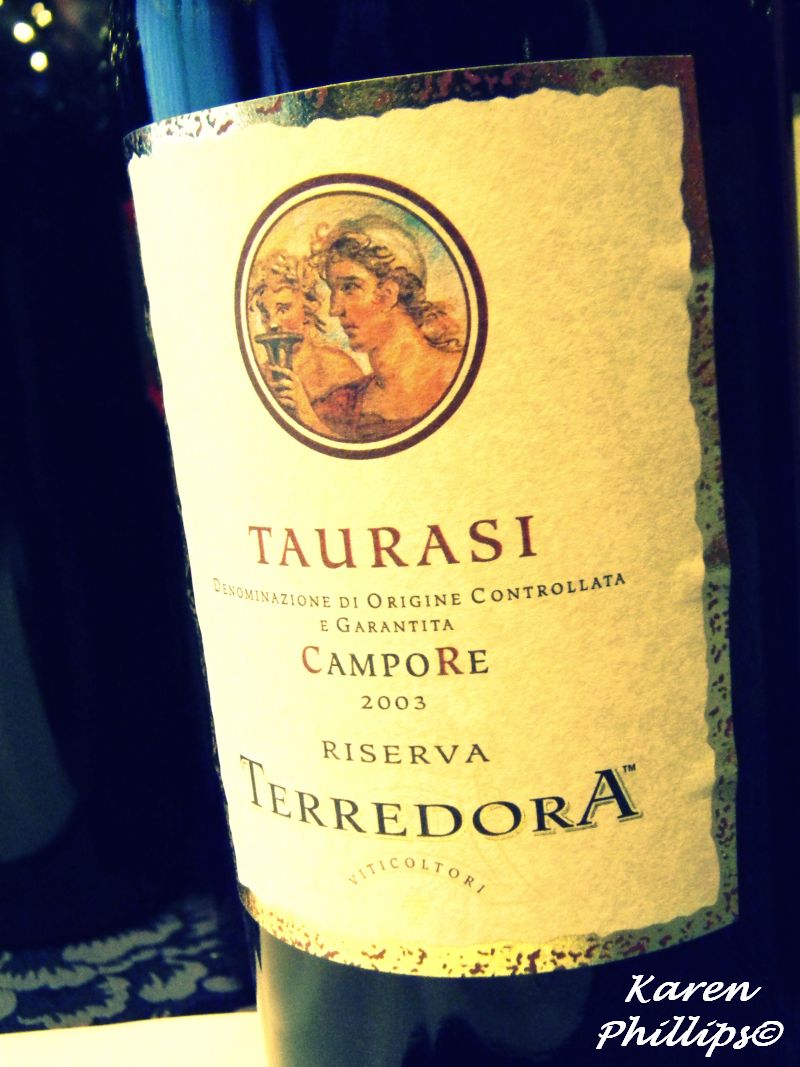
Campo Re 2003
Terredora
I'm familiar with Terredora...but not with Campo Re.  Interesting fusion of mature cherries...full flavors.  Subito my mind went to possible pairing options-Fusilli Avellinese with a rich ragu tomato sauce...or maybe a nice steak...


salvatore molettiere
Vigna Cinque Querce 2003 Riserva
Salvatore Molettiere
Montemarano in a glass... grapes harvested from Molettiere's beautiful vineyard  Cinque Querce.  A Taurasi aged in grande botte...big oak barrels.  Powerful.

Powerful is a word that I could use to describe Guastaferro, Di Meo, Pietracupa,Mastroberardino  and Di Prisco...


Taurasi Vendemmia Edizione 2013...so far so good....


Italian Version